Autopilot
I can’t shake the feeling I’ve betrayed a sacred oath by publicly divulging what I learned of the GPS glitch. Whistleblowers and those accused of sharing state secrets are one and the same in the eyes of the government these days, but I’m not worried about the consequences if this leak is traced back to me. That is to say, committing suicide by shooting myself in the back of the head twice is the least of my worries.
For the past few years, I’ve driven the same route to the facility. The trip started out taking between forty-five minutes and an hour, depending on beltway traffic. Over time, however, that trek had gotten longer and longer, some days pushing close to three hours. And let me tell you, a commute like that is a nightmare, especially for someone with little patience and too much road rage.
You’d think I was a lunatic if I admitted how many times I fantasized about going toe to toe with someone who blocked my attempt to merge or curb-stomping all the people who continually rode their brakes. I would get so furious when pulling up beside the offender. Most would refuse to acknowledge my existence, not that reacting to death glares would have helped matters. If that behavior weren’t bad enough, whenever my self-estimated arrival slipped even a second further into the future, my throat would burn from a torrent of curses fired like bullets from a Gatling gun.
I didn’t know what was wrong with me. The truth is, I hated myself for how I dealt with the stress.
Some days I wondered if I should’ve been excluded from agency employment because of my anger issues. As a contractor, there are a lot of hoops to jump through to even qualify for a position. If the company I worked for had known about the outbursts, they might not have put my name forward.
Whenever the thought crossed my mind, I immediately followed up by thinking that, of course, the agency knew. It was their job to know. Hell, it might have been one of the traits that gave me an edge throughout the whole vetting process.
Once I had gotten the job, a part of me understood something should be done to keep it.
But what?
The idea of accepting I had a problem seemed utterly alien. There would be no therapy, no talking to friends, no self-help. All those choices felt like a sign of weakness and would ensure a red flag would be added to my file. It never crossed my mind that any harm would come from my tendency to scream at strangers on the highway. Not until my luck ran out.
An incident occurred one morning when traffic was unusually heavy.
I missed an exit and decided someone deserved a berating. After speeding up alongside the offending vehicle, I unleashed audible hell. Unfortunately, I had failed to notice the car was an old Crown Vic, and I couldn’t understand why the man had given me this shit-eating grin. Everything became clear a split second later when the car’s lights began flashing blue and red.
Talk about a cooler.
The trooper’s smile never flickered, not even after he had me handcuffed in the backseat of the unmarked cruiser. I was on the verge of losing what I had fought so hard to achieve in life: the dream job, the perfect girlfriend, and my dignity.
Right then and there, I decided to find a way to prevent my emotions from getting out of hand, vowing that it would never happen again.
I had to trick myself into doing it. I told myself it was a bid to lessen the impact of the grueling daily traffic, not a sincere effort to fix any underlying problems. The lie seemed to get me over a hurdle. There’s a name for that kind of mental gymnastics, but whatever.
Over the next few weeks, I tried several coping methods: relaxing to classical music, catching more sleep, making dietary adjustments, trendy breathing exercises, etcetera, etcetera. Nothing seemed to work. It was easy to get discouraged.
Whenever I considered giving up, I would replay the dash cam videos and listen to my outbursts. They all seemed so trivial, especially the incident that got me arrested. Each time I rewatched that clip, I cringed at the sight of the officer’s glare and quickly regained determination.
After many failed attempts, I found what I had been looking for. The solution that finally helped was turning on the GPS. To keep control, I had to give up control.
It sounds silly, but that one detail dramatically changed my outlook. I don’t know how to explain it exactly, but I began to slip into a trance of sorts. It was like turning on autopilot mode. The vehicles around me no longer affected my mood. Other drivers wouldn’t even register. It was just me, lost in thought, mindlessly reacting to accidents, reroutes, or bad-weather slowdowns. I never paid attention to the road signs, only listened to the computer-generated instructions telling me when and where to turn.
That voice… so calm and soothing, programmed to use a trusting tone…
The technology had come a long way. The friendly yet generalized vocal pattern would sometimes seem to morph into a voice of people I had known. It would be my long-dead grandmother guiding me, or a lost love, or a good friend. But if I made any effort to focus on what I heard, it would immediately revert to the generic norm.
The subconscious is strange like that, right?
I was surprised by how quickly I learned to transition into that welcomed hypnotic state, allowing myself to be guided by those I cared about. There were other beneficial side effects, too. Travel time to the facility began to feel almost instantaneous even as the commute got longer, and instead of always being on edge, I would arrive feeling refreshed and ready for the day.
Life was good.
Life was real, real good.
Thank you, GPS.
All of that changed six weeks ago when management called me into a meeting. They gave me notice of a new security clearance check. In short, they said I needed to pass a screening to clear up potential discrepancies that the internal affairs division had uncovered. An interview had been scheduled for the next day. I was to report to agency headquarters and meet with a special investigations team.
Dumbfounded by the order, I muttered my assurance that I would attend. Meanwhile, my mind kept flashing back to the incident with the officer on the side of the beltway. I began to panic, feeling flush even as cold perspiration formed on the back of my neck. They gave away nothing, no hints as to what they thought I might have done wrong.
I stood to leave, hoping they hadn’t noticed my hands tremble. The logical part of my mind kicked in, telling me it had to be the traffic incident. But that didn’t quite make sense. The run-in with law enforcement had been minor; it happened long ago, and the charges were dropped. If something were to have come from the infraction, it would’ve happened much, much sooner. And if it wasn’t the arrest, I wondered, then what had they found?
I had done nothing wrong.
My record had been otherwise spotless.
Those facts didn’t help to alleviate the concern one bit, and concentrating on work was impossible.
The idea that there were any “discrepancies” had driven me crazy. By the time I left, I was a wreck, and the drive home was terrible. I couldn’t tune out, couldn’t lose myself as I’d grown so accustomed. I was keenly aware of every brake light, every lane change, every tailgater. And I had the sensation of being watched, as if the crimson-colored sedan three car lengths behind me was following me despite any maneuvering.
If that wasn’t enough, my GPS had decided to flip out. At each exit I approached, the mechanical voice would say to take it. Once I had driven past the suggested exit, the GPS immediately rerouted and prompted for the next, then the next. Traffic seemed fine ahead, so I ignored the prompts, finally shutting the damn thing off after the sixth annoyance.
When I pulled into the driveway, this sense of dread overcame me. Anxiety had pressed past maximum safe levels. But it was more than that. It was as if I had forgotten something of life-or-death importance.
I tried to sleep, only to wake drenched in sweat and clutching my chest. Nightmarish fragments of impossible things flashed each time I blinked. I couldn’t make heads or tails of the horror, but I remember the blood…lots of blood, and it seemed all too real.
That morning, I got out of bed feeling like I’d been hit by a truck. Keeping to my usual routine, I left at six a.m. and drove for over an hour. Then I suddenly snapped out of autopilot mode. I wasn’t sure why it had happened. I tried to relax again, but before I could, I realized I had been going the wrong way.
Strange.
I had followed the GPS directions. They had been softly spoken in my sister’s voice—not how she sounds now, but how she spoke when she was a little girl, happy, playful. Without much consideration, I concluded I had put in the address of the facility instead of headquarters out of habit.
I called management to let them know I would be late.
They asked why.
I lied, telling them it was traffic.
After hanging up, everything seemed surreal. I looked out the back window, feeling as if someone were watching me. Then I realized how unfamiliar my surroundings were. I was in a wooded area, nowhere near either the facility or headquarters.
Confused, I pulled to the shoulder and switched on my hazard lights. I figured the GPS had rerouted me for some reason, but that seemed unlikely. I had been traveling in the opposite direction of both locations. I sat there for a while, biting my lip and tapping the steering wheel as traffic whizzed past.
It had to be nerves. I had been so worried about the security check and had slept so poorly. The most likely solution was that I had simply entered the wrong address, neither for the facility nor for headquarters. Nothing else made sense. I pressed a button to check the destination history, curious to know what exactly I had typed in.
The system froze.
I tapped all the keys—unresponsive. Then, just as I was about to give up, the screen flashed and the history page loaded.
Blank…
Cursing the damned thing, I carefully entered the correct address. The GPS plotted a course, and I merged back onto the highway, nearly causing an accident with a speeding tractor-trailer. Luckily, it swerved into the next lane just in time to avoid a collision. I put a hand out the window, waving an apology and gritting my teeth for becoming the type of driver I hated.
Lucky for me, traffic wasn’t terrible, and I arrived early.
How Was Your Drive?
I went inside and gave my name. The security guards put me through a backscatter machine, searching for the smallest bit of metal. Once cleared, an escort met me in the lobby, prompting me to follow them to the elevators. We exited on a seemingly deserted floor where he led me to a darkened conference room.
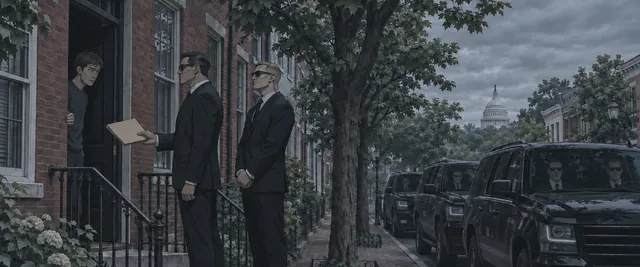
Several men sat quietly around the table. They looked like clones with their matching slicked-back haircuts and black business suits, each staring at the opening presentation slide displayed on the projector screen.
The nervousness I had felt the previous day paled in comparison to what I experienced at that moment. The caption on the slide, those humongous bold letters, spelled out my name.
“Welcome,” one of the agents said. “Please have a seat.”
I nodded and sat in the only empty chair.
“Thank you for coming in,” an agent across from me chimed in, then added, smiling, “We’ll try to make this as brief as possible.”
Before I could ask what it was all about and why my name was on the screen, the men began introducing themselves. I looked at each agent, glancing down at their ID badge: 1A6-Σ clearances, the lot of them. They all greeted me warmly, though I noticed that demeanor never touched their eyes. Disturbing, yet not at all surprising, considering what I had heard about agents with that special access level.
When formalities were out of the way, the clone who seemed to be in charge held up his hand, then tapped the table, calling for attention. He looked at me and began by using my first name as if we were old friends. And after a long pause, he asked, “How was your drive?”
“My drive?” I replied, taken off guard.
“Yes. Did you make it in okay?”
“I… well, um, a bit of traffic, sir. That’s all.”
“Please,” he said, “call me Tim.”
The introduction had seemed so strange. I had no idea what the meeting was going to be about, but I was certain it would be devastating. I wish I had casually checked my phone and, in the process, begun recording the conversation. Instead, I can only do my best to recreate it. Though not word for word, the context is accurate:
“Um, all right, Tim,” I said. “My drive was… it was fine.”
“Mine was fine, too.” He looked to the agent on his left. “Mike?”
The agent nodded. “Fine. Thanks for asking, Tim.” Then he turned to his left. “How about you, Dave?”
“Fine. John?”
“Fine. Nick?”
Nick shrugged. “I carpool.”
All eyes turned to me.
Tim said, “Nothing out of the ordinary? No need to stop?”
“Sir… Tim, I mean. I don’t underst—”
Dave spoke up. “It’s a simple question. We want to know where you were before this meeting.”
I stared at him quizzically for what seemed like an eternity before a lightbulb went off in my head. “Oh! I did get a little turned around. Ended up typing in the wrong address into the GPS this morning, that’s all. Glad that I wasn’t late.”
“Do you do that often?” John asked. “Type in the wrong address?”
“No, but…” I trailed off, the implication of their line of questions suddenly hitting me. “Am I… Am I being followed?”
“Followed?” Tim asked. “Are you worried about being followed?”
I shook my head, the crimson sedan flashing in my mind. “Of course not,” I said.
“Then of course we’re not following you,” Tim replied.
“Not anymore,” Nick added.
I jerked my head toward him, mouth hanging open.
“That’s right,” Nick continued, “we’ve gone back to using a GPS tracker again.”
I leaned forward. “Again?”
Tim cleared his throat. “Oh, we’re fairly sure you knew that already.”
“No disrespect intended, sir,” I said, stressing the ‘sir’ bit. “But I haven’t done anything.” I’d spoken slowly, taking a moment to look at each of them in turn. “So far all you’ve told me is I’m under surveillance. I’m just a database admin; why would you be following me? And why do you think I knew about it?”
After that, the agents remained silent, all except for Tim.
“We’re not accusing you of any wrongdoing,” he said. “It’s just the behavior. We are trying to understand. Today, for instance…” He seemed to study my face more carefully. “You said that you had put in the wrong address and got turned around. Yet you arrived early? Do you always give yourself enough time to account for the unexpected when traveling somewhere new?”
I thought for a moment. I hadn’t driven more than ten over the speed limit, and I had been far off course. How did I get there on time? I wondered. Maybe the GPS was malfunctioning? That hadn’t been the first random oddity in the past twenty-four hours, but even if that theory was correct, it seemed like an excuse that sounded like a lie that rang of guilt.
Tim glared at me, waiting for an answer.
“Some,” I said. “I don’t like to be late.”
“Admirable. How about your typical commute?”
“No difference. Traffic is unpredictable. I leave early enough to make it in on time.”
“How long of a drive is it to the facility?”
“Approximately two hours,” I replied, wondering what point he was trying to get at.
“Two hours?” He grinned. “John, next slide, please.” The screen flashed and the title page with my name changed to a map of the area. A thick green line materialized between two points, crisscrossing through highways and side streets. I recognized the route immediately: my house to the facility. “Does this look correct?”
Slowly, I traced the line with my eyes. “Yeah, that’s my route.”
“Looks to be the most efficient way. Next slide,” Tim said. The screen flashed once; an orange line replaced the green. It, too, began and ended at the same locations but took a slightly different path. “And this one?”
I studied it, then said, “Traffic. Best alternative route.”
“Mmmhmm. Next slide.” The line turned red. Mostly the route was the same, but with another slight deviation. “Accident redirect, I’m assuming.”
“Probably.”
“Next slide.” Again, the route changed, the line now showing in a darker red. “Next slide.” Another change, another color. “Next slide.” More changes. He repeated this until the route that appeared was so far removed from the original that I couldn’t recognize it. The slide changed again, back to the green path, the fastest from home to the facility. An ETA now appeared in a box below the map—fifty minutes.
My heart began to race. I tried to keep my breathing steady as Tim explained.
“This is how long your drive should take every day.” He nodded. “Before you ask, yes, this estimate accounts for normal traffic patterns and weather delays. So, if you would, please enlighten us on your two-to-three hour commute.”
I couldn’t speak, couldn’t even nod my head to indicate I had heard him.
Tim seemed to understand. He twirled his finger, gesturing to John. The slides ran through the different routes again, this time displaying travel estimates.
“Standard practice is to track agency personnel after any law enforcement incident,” he said. “You were arrested, and we began to watch you. Obviously, you’re free to take whichever roads you wish. It’s not our business if you choose to drive around before work. Many people do that.” He looked away from the screen and locked eyes with me. “But you are not telling us everything. We’re giving you this one chance.”
“Ye-yes, I am,” I managed, finding my voice again. “I admit to the mistake that got me arrested. I’m sorry.”
“Go on?”
“I feared being fired. And after the charges had been dropped, I tried to forget about it, hoping the agency wouldn’t ask for an explanation.”
“Disclosure of the law enforcement encounter wouldn’t have mattered. You were flagged the moment the officer ran your plates.” He frowned. “Ninety-nine times out of a hundred, tracking doesn’t uncover wrongdoing, and the investigation silently comes to an end. In your case, that almost happened. You wouldn’t have ever known. But your routine began to change, and that flagged you for continued monitoring. Are you denying it?”
“I’m not denying that my route changed. I began using the GPS each morning, that’s all. As for those routes, the ones you’ve shown me, they must be inaccurate. There’s no way.”
“Initial data suggested new GPS usage at first. But you didn’t stick to the optimal routes we’ve calculated. When the system was confronted with unlikely pattern deviations, it began a cross-check of foreign intelligence drop points.”
I laughed nervously. “You think I’m some kind of spy?”
“Safeguards. You never traveled near any of the known locations. Your case almost closed again.”
“Why didn’t it?”
“Right to the point. I like that. Well, the tracker began shutting off. There are short gaps where we couldn’t tell where you were. Never long, ten minutes, fifteen tops.”
That was too much to ignore. Regardless of how suspicious it may seem, I had to tell the agents what I thought. “I guess that’s when you began to have someone follow me?” I asked. “This will sound ridiculous… There’s a chance this is my fault. I rely on my GPS to… how do I put it… You could say it keeps me out of trouble. Hate to think I’ve been driving around pointlessly while zoned out, but either I’ve been going in circles for hours each day because of a broken GPS, or, as I said before, your data is completely wrong. What did your agent have to say?”
“You’re right. That does sound ridiculous,” Tim said, ignoring my question about the man who had been following me.
I shook my head. “Maybe the whole network is screwed up. Look at the paths. None of those turns make any sense. I’d never make so many contradicting moves without snapping out of it. Some, maybe, but not all. Plus, I’ve noticed these…glitches. I think they’re getting worse, too. The fact that it seems to shut off randomly supports what I’ve said.”
Tim smiled. “I’m going to level with you. We almost cleared your case on that belief. Almost.”
I narrowed my eyes. “What else could you possibly be concerned about?”
“We kept marking the tracking as faulty, no connection to known areas of activity. Despite our input, the system continued to flag your case day after day. So, we dug deeper. None of our analysts could decipher what was going on. It took a year for anyone to finally catch it. A savant, to be frank. See, they found the routes you’ve been taking aren’t random, despite how they look to everyone else.”
Staring up at the screen, I laughed. “If that isn’t random, then I don’t know what is.”
“The methodology is rather clever.” Tim shrugged, and the slide switched again, and again, superimposing each of the colored routes on top of one another. He continued, “Each route appears nonsensical, but when combined…” An animation played. The maps seemed to dance between the marked areas. “The system recognized a pattern, but the programming wasn’t there for it to explain why the case kept being flagged.”
“What you’re saying doesn’t make any sense. I swear I’m not trying to mask any locations.”
Tim smiled. “We’re sure of that. Besides, it’s not the locations along the routes we’re looking at. No, it’s the paths themselves. It resembles a message crafted over time, written in fractals and Fibonacci spirals and several other things beyond my limited understanding of the science.”
“You think the routes are spelling out a secret code? Like each street I take represents a word or letter?”
“It’s more complex than that. The closest analogy is that the paths mimic principles that govern the construction of an ant colony or beehive. I’ll leave that for the brainpower to figure out how you’re doing it. It’s my job to learn who is monitoring the code.”
I slammed my fist on the conference table and stood. “This is crazy! I already told you I’m not in contact with anyone! I don’t even have access to any critical information!”
“Please calm yourself. We aren’t ruling out the possibility that you don’t know who is behind this, but we’re confident you’ve had contact.”
“Because some system glitched out and showed me as offline? Because something is wrong with the GPS in my car and it’s not properly routing me? That isn’t enough to prove anything.”
“No, no,” Tim said. “It isn’t. We obtained a FISA warrant to search the records of all drivers in the continental US going back through ten years of historical data. Almost immediately, we found others who displayed similar behavior. We’re obliged to share this kind of data with our allies. They are finding the same thing. This network is bigger than we could have dreamed. It’s been growing in waves.”
I looked around the room, gasping for breath. “No. I’m not doing this. For some reason, it seems you’ve chosen me as some kind of scapegoat. There’s no way I can stop you from setting me up, but in the meantime…” I tore my I.D. from the lanyard around my neck and slid it across the desk. “Fuck you, I quit.”
Tim scowled. “For what it’s worth, the agent who followed you never reported witnessing any contact.”
“Talk to him then. Talk to any of those people who you say are in this so-called network.” I turned and walked towards the door. “They obviously know more than I do.”
“We would, but he’s gone dark. Two days ago, while surveilling you. No trace.”
I paused in the doorway but did not look back.
He added, “It happened right after another GPS outage. And as for all those other people I mentioned… the ones we’ve found, they are all gone, too. Like your signal, each one dropped off several times, then one day they vanished permanently. Aren’t you worried that your travel history is following the exact same pattern?”
A chill ran down my spine. I resisted the urge to go back, refused to listen to any more of Tim’s crazy story. “If you have any more questions, talk to my lawyer.”
The agents chuckled at that.
As the door closed behind me, Tim yelled, “When they have what they want, whatever it is, you’ll disappear, too! I doubt it will be your choice!”
The Dash Cam
I ignored the warning and quickly made my way back to the elevator. I was surprised that none of the guards stopped me on my way out.
Once in my car, I reflected on everything that had happened in the conference room.
Tim had shared so much, more than he should have. None of it made any sense, as if it were a demented practical joke that had gone too far. I was positive they had held back some critical pieces, but whatever they knew, it must not have been enough to take me into custody. The most likely strategy was that he only gave away details he had thought I already knew, looking to rattle me into revealing a secret.
I considered the different possibilities and thought of ways to either prove or disprove the accusation. The simplest method was to manually time my drives to the facility. I could find out exactly how long it took. I knew it took longer than he had tried to tell me. I could even record the trip to—
My eyes shot to the dash cam.
I had been recording.
Every drive I took for the past few months had been automatically uploaded to my home server. I jumped out of the car, ready to go back and tell the agents. Halfway to the door, I stopped. What if they were trying to frame me for something? What if they confiscated the only proof of my innocence? I decided instead to watch the clips first and make backups. After that, I would turn everything over. That is, unless they rendered me to a black site before then.
I started the car and headed home.
Like the day before, the GPS prompted me to take alternative routes. When I pressed the key to zoom out for a full view, the screen flashed and the original path returned. I punched the dash and gritted my teeth at how insane the whole situation seemed. “Where you trying to take me?”
What if Tim was right? What if thousands of people were like me, listening to the GPS without realizing the path it would lead to?
As I drove, I imagined a virus had infected the GPS network. Maybe someone was communicating with each other without the driver’s knowledge? That seemed insane; people would know. Drivers would realize something had gone wrong any time they knew the way and the system kept telling them otherwise.
At that thought, a new sense of dread came over me. I felt as if I was close to understanding something of life-and-death importance. I kept glancing from the GPS to the dash cam. Oddly, it was the dash cam that bothered me more. I couldn’t recall where I had gotten it or why I hadn’t thought of it in over a year.
The question kept returning, again and again.
People in Eastern Europe need a dash cam to protect against someone throwing themselves at their car, sure, but not in the States. And I never worried about theft or other people driving. So why then did I have one? When did I get it?
The whole way home, I obsessed over the mystery. In the deepest, darkest part of my mind, I knew the answer would be on the tapes. I was equally confident I wouldn’t like what I found.
Now, as I’m telling my story, a different question haunts me…
When slipping into insanity, does it happen gradually or all at once?
I doubt I’ll ever know for sure. All I can say is it happened sometime during the week I spent locked in my apartment, watching each video. Hundreds were there, going back to a month before my arrest.
I started at the beginning.
The first few entries confirmed what I’ve already explained—me stuck in traffic and pissed off. I scrubbed through bit by bit, slowing down wherever there was audio. I listened to myself curse at other drivers, and I cringed at how much of an asshole I had been back then. In one of them, I turned the camera around and said, “See, it’s not me. This is what I deal with every day.”
I paused, not remembering ever saying anything like that. And who was I talking to?
Soon I made it to the arrest video. The incident happened just like I recalled. As I watched the cruiser pull away with me in the backseat, I clicked over to the next video, then paused suddenly.
Something wasn’t right.
I went back and watched the arrest again, looking for any clue. After the encounter, I let it play in fast-forward, watching the cars and trucks speed by, wondering what I must have missed. Three hours passed in mere moments, then one of the cars pulled in front of mine, and the door opened. At that moment, I realized I had been squeezing my fists hard enough that my nails had drawn blood, then quickly slowed playback to normal speed.
A girl stepped out of the passenger side. Her ride pulled back into traffic as she waved goodbye. She turned toward the dash cam and began walking toward my car. I gasped. I knew her. Somehow, but I couldn’t remember.
I paused the video, unable to tear my eyes away.
“Amy,” I whispered and gently touched her hair on the screen.
I pressed play again and watched through blurry eyes as she passed from view. My car started, and she drove away.
Then she said, “I tried to warn you, mister. After I bail you out, I’m going to make you watch this until you admit you were wrong.” She laughed.
The video continued silently. Amy drove to my apartment, got out, and went inside.
What I witnessed caused dual realities to clash in my mind. One moment I knew that was Amy, my girlfriend. She had picked up my car and driven it back home, then bailed me out of jail later that evening. The next moment, that all seemed wrong. My car had gotten towed, and I was released on my own recognizance. And I had never dated or had known anyone named Amy.
Even as I struggled with that impossible contradiction, I kept going through the tapes. A day passed with the car sitting idle, and the next morning I saw myself get back in, looking despondent. The sky was gray, and soon it began to rain. Brake lights filled the road ahead. Then the dash cam turned around and focused on my face. “Look at me out here trying not to get pissed off.” I smiled. “Thanks again for the birthday gift. Love ya.” I turned it back towards the stopped cars and sighed.
I watched more and more footage, telling myself it was a joke, a plant, something the agents would use as evidence against me. I hadn’t recorded any of those moments. And I couldn’t admit I honestly knew Amy, regardless of how much it hurt to see her face appear briefly in several videos.
Nothing strange seemed to be happening, otherwise. I sped up the playback again and watched several more. Each video showed stop-and-go traffic, a turn here, a turn there, then pulling in to park at the facility. It wasn’t until after a month of tapes that I noticed the elapsed time was, in fact, increasing.
I scrubbed back and found a spot where the deviations seemed to have started. As I watched through again, I focused on the turns, writing down which streets, which direction, and most importantly, marking when they happened. I stayed up for two days straight, plotting the routes. By the time I finally passed out from exhaustion, I had accumulated four months of turns.
Before continuing with videos, I built maps much like those that Tim and his agents had shown me. I wasn’t at all surprised to see they closely resembled what I remembered from the meeting. Either he was right, or the tapes were a damn good fake.
On the fourth day of my video review spree, one of them had started to get blurry, then it turned black halfway through a turn. It resumed a short time later, the tape clear again, and the drive resumed without further incident. I looked at the spreadsheet full of turns and noted the road the blackout had happened on. I looked it up online, planning to do a street view to see if any of the homes or businesses seemed suspicious.
The thing is, I couldn’t find the road.
Assuming I’d written it down incorrectly, I watched the video again.
No, I had the name. I just couldn’t find it.
I decided to check the cross street and discovered it without any problem. From there, I tabbed through each image from one block to the next. The road I was looking for, the one I had turned onto in the video…it wasn’t there.
Even though the recording wasn’t as clear as the others before going dark, the road signs had still been legible. The explanation seemed obvious. The road must have been constructed after the last map update.
Not a problem, I thought; I would just drive there and see for myself.
I left immediately.
Out of habit, I typed in the address to the facility. I followed the first half of the route, not realizing the GPS was even telling me the turns I had already planned to make until I hit a place where a deviation would take me on a more direct approach.
The GPS complained and tried to reroute me. I clicked the map button to get a larger view of the area. The system glitched again, freezing a second after I pressed the key. But before it did, something strange caught my eye. The route wasn’t standard. It looked like what Tim had shown me in the final slides. But after the flicker happened, the route returned to the one I had known and traveled for years.
Or so I thought.
It didn’t take long to make it to the cross street. I followed the winding road, expecting the new street to appear around the next bend based on my recollection of the video. Imagine my surprise when I came to where the street should be, only to find that it was not there.
I don’t mean it was blocked off. I mean it wasn’t there.
The street that I had taken in the dash cam video did not exist.
It couldn’t have existed either. Tall trees stretched for a mile in both directions on both sides of the road. There was no way I missed it. Even so, I drove back and forth along that stretch of road for many hours, giving up only after my car had run low on fuel.
On the way home, I thought about how the videos could have been faked. But that didn’t explain why I recognized the girl, Amy, though I couldn’t remember anything else about her or the dash cam she had apparently given to me. I felt the need to see her once more; then, after that, I would delete all the videos and wait for whatever may happen next.
The next dozen videos were the same. Visibility became worse and worse; the world blurred and shimmered. It was like seeing streaks of light through smudged glasses. Then the videos hit the blackout point. Out of habit, I marked the streets and researched.
In some cases, the blackouts happened much like the first one did, making a turn onto a road that did not appear to exist on the maps, but in others, the streets did exist; only the names were different from what showed up. On one video, I’m traveling down the freeway on my way home, then veered off on an exit; only that exit shouldn’t have been there. By that point, I had gotten used to seeing it happen, but the instance triggered a recollection from a few years ago about a planned interchange. I recalled the project never happened.
Before looking up the plans, I knew the exit would have been exactly where I had turned in the video. Sure enough, I was right.
As crazy as it all was, I honestly didn’t care anymore. The only thing I wanted was to see Amy again, so I kept going.
Now I wish I hadn’t.
Near the end of the list of recordings, I saw myself leaving the house. Amy followed me, holding a small suitcase. We both got in the car.
As the doors closed, my heart began to race. Out of all the videos, this supposed girlfriend had never once driven anywhere with me. I played the tape at normal speed and listened to the conversation.
In the first few minutes of the video, we chatted about my weekend plans, and she gave a promise that she would be back from NYC before I missed her. I asked about her mother, who apparently was not doing so well; she had had a stroke the previous night. After that, we drove in silence, except for the voice of the GPS guiding us toward the airport.
We made it out of the neighborhood, onto the highway, the beltway, the freeway.
Then a redirection.
And another.
And another.
Fifteen minutes after we left the last major highway, Amy said, “This thing’s taking us through bum-fuck. My flight’s in an hour. What the hell?”
I didn’t reply, just kept driving, following the directions.
“You look like you’re about to pass out,” she said. “Sorry if I kept you up last night crying. Want me to drive?”
No response.
She said my name, waited, and said it again. The video began to blur. “Hello? Why aren’t you answering me?”
Prompted by the GPS, I turned again and again, and the video became blurrier and blurrier.
“Are you done?” she asked, her voice quivering. “I’m trying to hold it together, and now you’re an asshole for no reason.”
The car slowed and pulled to the side of the road at the next intersection. Nothing could be seen except grass and pavement far into the distance.
“What’s wrong with you?” she asked as the GPS prompted me to turn left. “And where is that thing trying to take us?!”
I finally answered her. Or, at least, I think it was me. The voice was cold and distant, and it sounded like a bad recording of a bad recording. I said, “Your destination is ahead.”
The driver’s side door opened, and I got out.
“What are you doing?” she asked.
The trunk opened and closed.
“You’re scaring me. Stop!”
Her door opened, then she screamed.
“Let me go!” Her scream became muffled, as if struggling.
Then I saw myself appear in the frame. Amy was still screaming, loud, shrill, terrified. And then I saw I was dragging her towards the intersection by the hair. She’s clutching at the pavement, scraping hands and knees. I noticed something in my other hand. The view was too blurred, and at first, I couldn’t tell what I was holding.
While the scene played out, I pleaded at the monitor, “No, no, no.”
The strange voice repeated the message: “Your destination is ahead.”
My arm rose high, hand gripping a long piece of bent metal, and then I recognized it was a tire iron.
Amy screamed my name again, pleading.
The tire iron came down so quickly and with such force that her skull split open. Her arms shot straight forward, wrists bent at a disgusting angle. She shivered once before her whole body slowly relaxed. I let go of her hair, then dropped the weapon.
The scene was one I recognized.
It had played out exactly like one of my old road rage fantasies. But seeing it, taking in the truth of what it meant to bash someone’s skull… It was too much. My stomach churned. Bile filled my mouth. I turned my head and threw up while watching my onscreen self.
In the middle of the intersection, I stepped backward away from Amy, avoiding a growing puddle of blood and brain that seeped out from her twitching, ruined face. As I stepped back, I was staring left, into the distance, the direction the GPS had said to go.
Then a vehicle appeared—a crimson sedan. And I do mean appeared. It didn’t simply drive into view; rather, it materialized as if emerging from a fog.
The sedan stopped alongside Amy’s body and the front doors opened.
Two people stepped out. One approached Amy, the other walked around her body and stood inches in front of me. I couldn’t see their faces or what they wore. It wasn’t the blur in the video either. I could focus on myself and Amy, but not them. When I looked directly at either figure, my head began to burn, and the intensity of the pain grew the longer I tried to make out any features.
The person by Amy hunched over her body. It lifted her head and rested it on one of their hands. Then they used their other hand to probe the wound, fingers digging deep into the gash. The one by me stepped closer. We stood nearly nose to nose. They gripped the back of my neck and seemed to be whispering something to me, very fast, very intense.
I was so caught up in trying to make out what was being said, I didn’t notice that something was happening with Amy. She let out a long, pained screech. Her body trembled, one foot kicking at the ground. Then she stood up. She stood, turned toward me slowly, and with blood covering half her face, she said four terrifying words: “Your destination is ahead.”
Without any sign to each other, the two figures got back into the front seats while Amy got into the back.
The sedan started, made a U-turn, and disappeared into a fog that wasn’t there.
I watched myself turn towards my car, face lifeless. Mechanically, I walked to the passenger side, closed the door, then walked to the driver side, got in, and started the engine. The car idled for a moment, then slowly rolled toward the intersection. The GPS prompted me to turn left, the same direction from which the sedan had come and gone.
As the car turned, the blur intensified, then the video cut to black.
You Have Arrived
I shut off the computer and sat there for a long while, trying to think of a way out of hell. Deleting everything wasn’t an option anymore. The agents hadn’t lied to me. This wasn’t a setup. It might have seemed like it when all I had was videos of scenic drives cutting to black when reaching a nonexistent road. Those things could have been faked, I knew, but not Amy. Not the video of what I had done to her.
Tim had said to me that other drivers had followed similar behavior before finally disappearing. How many? I wondered. Hundreds? Thousands?
I called headquarters and left a message for the investigation team. I let them know they were right about my being in contact with someone and mentioned the dash cam footage.
The response came within an hour. Instead of a return phone call, I was greeted by a team of agents brandishing a search warrant. They burst in, handed me the paperwork, and began to tear everything I owned apart. They didn’t ask any questions or demand any statements. Some took photos of each room while others scanned for electronic devices and seized any computer equipment.
When they left, one of them even thanked me for my time.
As it so happened, they had left me with a critical piece of information. The printout of all the turns had been in my pocket, and I couldn’t just sit around waiting.
I decided to go to the location where I had last seen Amy.
Like usual, I plugged the address into GPS, but it tried to send me elsewhere. So…I decided to follow. I took the first turns as suggested, and the system glitched again, rerouting me back towards the crossroads. As I traveled the route to the original destination, I wondered what might have triggered the glitch. I hadn’t hesitated, missed any turns, or touched the device.
As I approached the intersection, I wasn’t surprised to see a man standing in front of a car on the side of the road. He waved, and I waved back, pulling in behind his vehicle.
“Hello, Tim,” I said, getting out of the car.
He nodded and turned around, heading towards the crossroad. “When your tracker began to move, I thought you might come here.”
I walked up to his left and stared out at an empty field. The road from the video wasn’t there, but a faint indentation stretched into the distance, a sign that a road had once existed. “How did you know?”
“This is where we found the first piece of hard evidence, the reason we called you in—a tire iron with your prints and traces of blood. Turned out it wasn’t our missing agent’s, though.”
“So you’ve seen the video, seen what I did to Amy?”
“No. But I have an idea.”
“So what happens now?”
“Nothing,” he said, then turned and walked toward his car. “Thanks for the recordings. I don’t think I need to tell you to keep this to yourself.”
“Wait!”
He looked back and raised an eyebrow.
“These locations, what are they?”
He shrugged. “Like anywhere, I imagine. Places that used to be, could have been, or never were. I’m sure I’ll find out soon…my GPS just started acting strangely.”
I opened my mouth to say something else, but Tim got in his car and drove away.
My story ended there, or at least it should have.
Over the next three weeks, I tried to put my life back together. First, by getting my job back at the facility. That was easier than I thought it would be. The agents never reported that I had quit. Two days after talking to Tim, when Amy had vanished, I received a call from management asking what day I would return from vacation. That covered the money, so the second step was trying to pretend I had never seen the videos.
I figured I had been a pro at lying to myself about the road rage, so how hard could it be to forget seeing yourself murder a girlfriend whom you couldn’t remember?
Of course, I was full of shit.
I dreamt about Amy each night, always waking up screaming. And each morning, as I drove to work, I would listen carefully to the GPS, ready to follow any redirects. When I did, however, the system would immediately glitch and put me back on the conventional route. In the evenings, I went through multiple tanks of gas trying to recreate the original paths, looking for clues along the way. But they always ended at either an average road with a familiar name, or a place where a road never existed, or a ruin where a road had once been.
The situation was hopeless.
In time, I gave up, stopped trying to figure it out. I went to work and came home like any normal person would, though the problem always stayed in the back of my mind.
Tim had said the paths were like a message written in time, and I think he had meant the roads taken were read by someone as an indication it was safe to meet. The way I saw it, the roads were a lock, and the GPS wasn’t giving directions to the location, but giving directions to unlock the real destination.
One morning, as my mind drifted and considered those possibilities, I was listening to Amy’s warm voice telling me to turn and turn again. So, I thought, if roads are the lock and the GPS the directions, then what was the key? Amy told me to turn again.
Amy…
I shook my head, snapping out of autopilot. Then I slammed on my brakes, instantly realizing I wasn’t on the right highway. Before I could do anything else, the GPS glitch happened, and the system redirected me back to the original route, spoken in the standard robotic voice.
In that instant, I knew I had found the true key to opening the lock.
I theorized that the GPS could pick up whether someone is caught in a driving trance or if they are fully conscious. If true, then that explained the glitch.
It’s not the system.
It’s our minds.
Before the realization fully sank in, I had thought of different ways to either trick myself into regaining consciousness after following the path or to fool the system into thinking I was still on autopilot.
It took a week of trial and error, but I finally figured out a method that worked.
I won’t share the details.
I don’t want to be responsible for what would happen if the steps are repeated. It’s only important to know I crossed the threshold of my own free will and traveled the hidden, dark roads while wide awake.
I wish I hadn’t.
I’ve been gone for what seems like a lifetime. And I would do anything, anything to forget the countless horrors I have seen. The words to describe them do not even exist for us here. I know I should have been lost forever, like so many others, but by some miracle, I fought my way back through the monstrosities, taking road after road until I finally found home.
The glitch is real. I’ve shared everything I know. Before Tim and his agents or a crimson sedan show up at my apartment, here is one final warning:
Don’t trust GPS.
Be wary if you notice your daily commute time change. Be afraid if there are periods of driving you can’t recall. It might be the glitch.
You see, I’ve done horrible things, recreated every dark fantasy that had ever crossed my mind. And I know what happens to those who traveled past the point of no return.
My biggest mistake was never considering the directions might continue after making a turn down an impossible street, leading out of our world. None of what I’ve seen or done compares to the real nightmare that began when Amy finally stopped telling me where to turn, when her loving voice told me: “You have arrived.”
The end