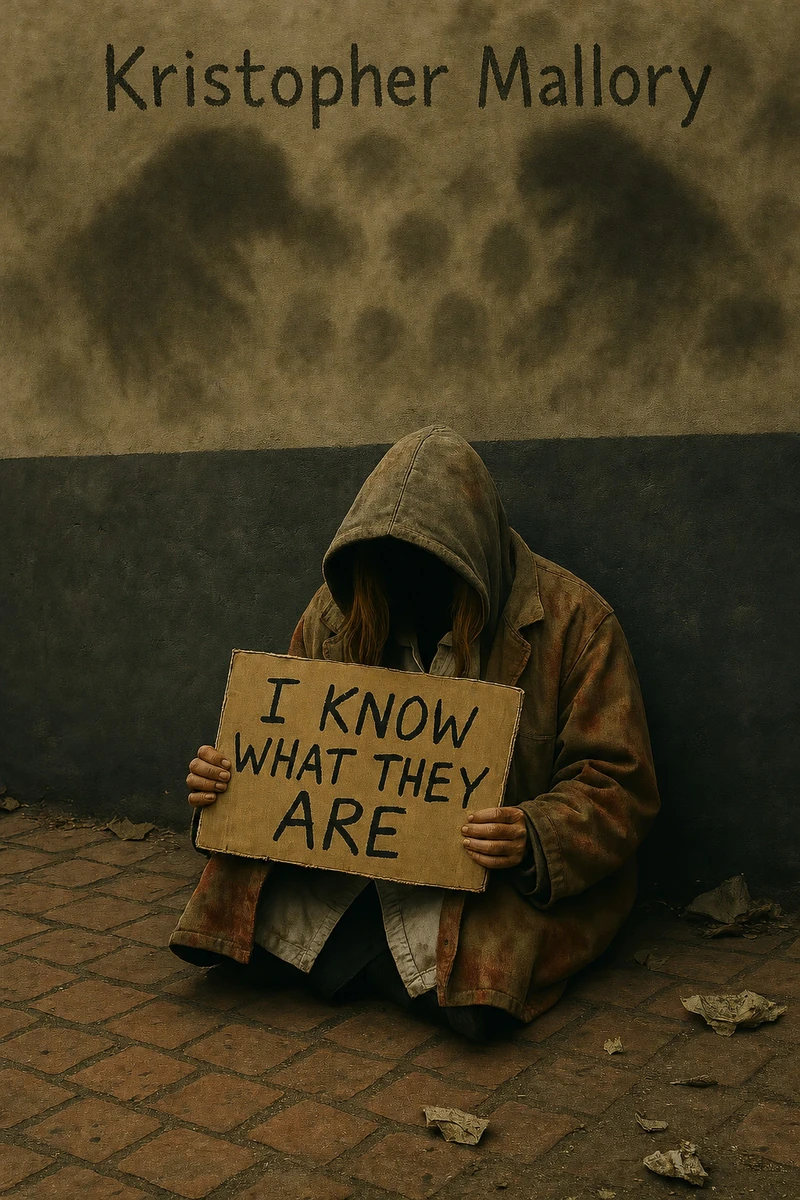
Meeting L.
The sign read:
Will work for food.
The homeless man holding the cardboard wears mismatched shoes and stinks of alcohol. There’s a spark of lust in his otherwise worn eyes. He licks his lips and mumbles some vulgar line about my skirt while staring at my breasts. His voice slurs so I don’t quite make out what he says. The message is still clear—money isn't the only thing he'd like to get his hands on.
Despite his rude behavior, I realize he doesn’t have a clue about surviving on the streets. His sign, ‘Will work for food’, doesn’t work on anyone. With a different sign, he’d have a much better chance of squeezing a few extra coins from the morning commuters.
He stumbles in front of me and reaches out a hand. It looks as if he’s trying to steady himself, but I know he’s trying to cop a feel. Some women might get upset at this, but I’m used to dealing with his type camping along these sidewalks. I do what I always do: side-step his reach, pay him a friendly smile, and continue walking down the block.
The homeless aren’t all creeps. Most only want to master the art of looking pathetic while cradling their Sharpie-written messages and shaking a cup with a few nickels and dimes inside.
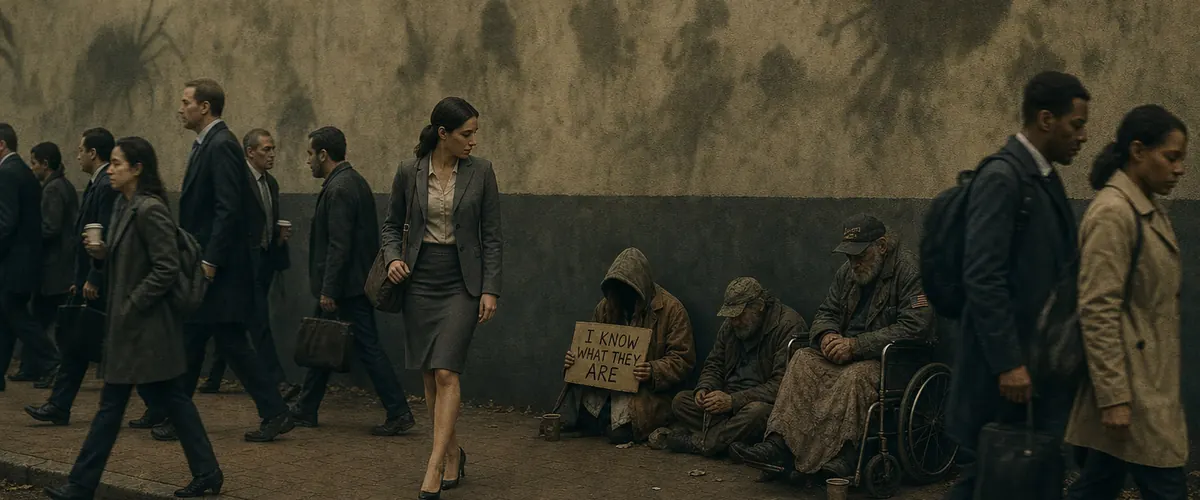
Half a block later, Joe, the legless Vietnam veteran, calls out, “God bless, ma’am.” He's one of the regulars along Skid Row. He's been sitting in the same spot on the corner since long before I moved to the city, and he’ll probably be sitting in the same spot long after I move on.
He waves to me as I approach his busted wheelchair.
I smile and wave back.
The sign read:
Disabled.
Got No Family.
God Bless.
“Good mornin’, Joe. How are you?” I drop quarters into the vintage He-Man lunchbox he keeps in front of him on the pavement.
“‘Twice as fine as yesterday an’ half as fine as tomorrow.”
While I’m searching my purse for more quarters, Joe calls out to someone else. “God bless, mister.” He taps his finger to his forehead in a salute.
The man—Mr. Business Suit—shoulders by me, spits at Joe, then shuffles off toward the side street.
I clench my fists. “Hey!”
The man flips me off without turning around.
Seething, I want to give chase, but running in stilettos is nearly impossible. I’m about to kick the shoes off when Joe says, “Ain’t no need for anger, ma’am. He do it every day.”
“What?” My jaw drops. “That man spits on you every day?”
Joe nods. “I tell him God bless just the same. Don’t bother me none.”
I take a deep breath and let it out slowly. “You’re a good man, Joe.”
“I try to be, Ms. Tammy. Can’t let a thing like that change ya heart, understand?”
“Thanks for the advice, Joe,” I say, nodding.
“No, ma’am, thank you.” He waves me away. “You have a blessed one. Go on now.”
“See you tomorrow?”
Joe smiles. “You know where to find me.”
Talking with Joe reminds me of my father. That man had known what respect meant. He had often said, “Tammy, honor everyone until they prove to be unworthy. Then you tell them to kiss your ass.”
Joe seems to live by a slightly different philosophy. Someone must’ve taught him that being spit on isn’t reason enough to stand up for yourself. Maybe that’s why he’s still on the streets?
No, that isn’t fair. Anger doesn’t change anything, and I’m positive that confronting someone like Mr. Business Suit would’ve been pointless. Not much you can do when someone has their head that far up their own ass.
The do-not-cross light flashes red at the main highway intersection, and I join the crowd waiting for it to turn. All around me are office workers, lawyer types, and doctors. I spy a young nurse wearing yellow scrubs. A loud country song is escaping from her earphones. She's bouncing along to the beat and lip-syncing the words. The light changes, but my attention is still on her. I’m curious how she'll react to the pregnant junkie swaying back and forth on the steps of the defunct bank.
The sign read:
Spare change please?
Trying to pick myself back up.
The pregnant junkie begs, “Help me for the sake of my unborn baby.”
The girl in scrubs averts her eyes. Like everyone else, she’s trying to pretend that the poor and lost don’t exist. I find that kind of attitude disheartening. I nod to the pregnant junkie but don’t give her any money.
Farther down the drug block, two shady-looking fellows with vacant eyes and sallow faces covered in sores stand in the doorway of a burnt-out row home. A noxious plastic smell emanates from the glass pipes pressed to their lips.
The people here are the worst. These are the real addicts. No one stops in this part of the city, not even the police. No surprise, really. Anyone stupid enough to do that would likely be robbed by one of fiends for a watch, wallet, or even a pair of shoes. They’ve even been known to kill people getting in the way of them scoring their next hit.
One of the men wears a clerical collar. His cardboard message is propped up on one of the steps.
The sign read:
In Recovery. Please Help.
I cautiously walk by, keeping eye contact. The priest smiles a mouthful of broken, blackened teeth, and makes the sign of the cross.
My God!
It isn’t fair to judge, I know, but…my god.
I’m biased. I’ve seen how far my father fell once he took up the pipe. I try my best not to form opinions based on outward appearances, no matter how bad, because I know that mixed in with all the addicts, drunks, and lunatics are those who have lost everything through no fault of their own, or in some cases, simply because of an accident. I know how horrible that feels… firsthand.
A memory flashes through my mind: My father laughing hysterically on the front lawn as flames devoured our home. My mother is struggling in the arms of a fireman. The fireman is trying to pull her away from the intense heat. Crying, she breaks free of his grip, runs toward the inferno, and disappears into the thick, black smoke.
I shudder and raise the collar of my coat, pretending that my reaction was caused by an ice-cold gust of wind.
The next light changes, and the crowd moves back into safer territory. I approach a makeshift shelter with a sad-eyed child huddled underneath, clutching his knees to his chest. He nods as I drop a dollar on the wool blanket he’s using as a mat.
The sign read:
The boy is alone.
I notice everyone else passing by as if they don’t see the little boy, and I pause a moment, wondering what else I can do to help him. There’s nothing, so I just sigh, then mutter, “Good luck,” before running to catch up to the herd.
Nowadays, the sight of pain means jack shit to most people. So many have become desensitized to the agony that surrounds them. They don’t realize that anyone can end up out here. All it takes is a spark at the wrong time and place, and your whole world can burn to the ground. I’ve lived in the gutter and know all the secrets those stinking pits hold.
I look at the faces around me. It seems that almost everyone wants to go on in blissful ignorance. That’s fine. I’ll continue to nod and smile at the forsaken. I’ll offer the acknowledgment that they deserve and try to help them when and if I can. Sometimes I think I should make friends with one of the other people in the morning crowd…maybe that young nurse still bobbing along to her country music. I could tell her about the gratitude that shines in the eyes of the less fortunate simply by making eye contact.
Turning the corner, I chuckle softly at the sight up ahead. The comedian is sleeping in the middle of the sidewalk, like usual.
The sign read:
If frustrated throw quarters.
Smiling, I step over him and continue on my way to the shortcut through an alley.
I leave the herd and round the overfilled dumpster near the passageway between two slumlord-run apartment buildings, a shortcut to my office building. A melancholy woman wearing a dirty lab coat is standing at the mouth of the other end. Oddly, she’s covering both of her eyes with her palms. The writing embroidered over the lab coat’s left breast pocket identifies the owner as L. Porter, Ph.D. Below the name, in bold letters, CERN
I step through a brown puddle, and the woman lowers her hands. The expression on her face is a familiar mixture of confusion and grief. As I make my way closer, chills run down my spine. The pain etched on her face reminds me so much of my mother. She kneels and picks up a damp piece of cardboard then holds it out with shaking hands.
The sign read:
I know what they are.
I experience Déjà vu. Without realizing what I'm doing, I stop inches in front of her. Words come out of my mouth all on their own. “Hello, my name is Tammy. Would you like to join me for a cup of coffee?”
“Yes.” She nods. “I’m L.”
L. seems to stare at the teenage waitress carrying a tray to our table. As the girl sets down the two coffees, she shudders and says, “Whoa, that's weird. That thing just happened to me. You know, what’s it called?”
“I’m sorry.” L. shakes her head and says to the girl, “You’ll never be a veterinarian.”
The waitress cocks her head to the side. “Excuse me? Did you say vegetarian?”
L. shrugs. “I said you won’t be a vet.”
The waitress seems to fake a smile and says, “Oh. That’s good, I guess. I don’t like cats.” She blinks. “Dogs either,” she adds, then blinks again. “In fact…I hate all animals.”
Unsure of what the exchange was all about, I say to the girl, “Thank you. If we need anything else, we’ll ask.”
“Sure thing.” The waitress smiles politely then walks away.
I attempt to strike up a conversation about the lab coat L. is wearing. “I’ve heard of CERN,” I say, “but I can’t remember how I know the name.”
L. shrugs.
“Where did you find the coat?”
L. takes a sip of her black coffee. “It keeps me warm at night,” she says. Her face twitches slightly, then her eyes quickly dart around the room before looking back down at the steaming cup in front of her.
“L.?”
She looks up at me.
“Where are you from? Is there someone we can call?”
“It doesn’t matter where you’re from,” L. says. “It only matters where you used to be going.”
“Used to be going?” I begin to wonder why I’m even sitting here.
L. blurts out, “Thanks for your kindness. I really must be leaving.” She bites her lip and then says, “Also, I’m really sorry about your children.”
“Children?”
“Yes.”
“I don’t have any.”
“I know.”
“I’m not sure if I even want to be a parent.” I consider it for a moment and decide I don’t. “It’s a huge responsibility.”
“Do you know your name still?”
“Of course I know my name,” I say, furrowing my brow. “It’s Tammy.”
L. reaches over and takes my hand. Tears form at the corners of her eyes. “I’m terribly sorry about your children, Tammy.”
The way she spoke made it sound as if they had died in a tragic accident…a fire. I’m upset for a moment. L.’s sincerity over my nonexistent children had dredged up another unwanted detail from my past. I don't know how to respond. If I even try, I’ll break down, so I just stare into her dark eyes. A few long seconds pass, then L. releases my hand and quickly makes her way to the exit.
“Wait!” I call out a bit too loudly, and the other patrons begin to stare.
L. turns toward me and raises her eyebrows.
I know I shouldn’t stop her, but I’m compelled to find out more. The cardboard sign is tucked under her arm.
I stand and walk over to her. “Just wanted to ask…” I hesitate. “I mean, I noticed your sign?”
L. clutches it tighter. “I know what they are.”
“Who are 'they'?”
“Not who, but what, and you don't want to know about them.”
“Then why do you carry the sign?”
“Why not?”
“This isn’t going anywhere.” I try a different approach. “Have you sought help? I know a doctor….”
L.’s eyes narrow. “Things were better when they were secret,” she says.
“If you don't want to tell me about them, it’s okay.”
“Mandy?”
“No. I told you, my name is—”
“Tammy! I’m bad with names now.” L. takes a deep breath. “You seem like a good person. If I find out what they are, you will get hurt again.”
“What do you mean, again? You keep saying these things, and I don’t understand. You know what, never mind. I'm sorry that I asked.”
“The choice is yours,” L. says with a hint of sadness in her voice. “Meet me tomorrow if you really want to know.”
Before I can respond, L. pushes open the door and runs down the block. As I watch her go, it occurs to me that L. is the definition of insane. Even so, I can’t deny the connection I feel. There’s a crushing depth to her hopelessness which had somehow pulled me in.
It’s extremely dangerous to associate with the mentally ill, but…I need to know what they are.
The following day, I find L. sleeping in a cardboard box. Her blue Solo cup is on an overturned milk crate. It only has a few pennies inside. I grab some cash from my purse, and as I’m about to place the money into the cup, I realize it’ll most likely be stolen before L. would find it.
“Hey, it’s Tammy. Are you awake?”
L. rolls over, grabs her cardboard sign, then holds it over her face like a protective shield.
“Hey, calm down. I’m not going to hurt you.” I try to reassure her by keeping my voice as slow and steady as possible. “We had coffee yesterday. Do you remember?”
L. nods.
“I want to give you this,” I say, holding out a twenty.
Gracefully, she takes the money from my hand and says, “Thank you. I’m sorry about those goosebumps.”
It's true, the hair on my arms is standing on end, but I’m wearing a thick jacket today so I don’t see how L. could’ve known about the chills. I laugh. “Someone must’ve walked over my grave.”
L. swallows hard, then shakes her head. “They didn’t walk over your grave,” she says. “They stole eight years and five months of your life.”
Once more, the hairs on my arms rise, and a deep shiver accompanies the eerie sensation of Déjà vu.
“Three more years and nine months,” L. says. “Plus, I’m sorry you’ll never find true love.”
“That’s silly,” I say. “I’m twenty-seven. I don’t have the time to deal with a serious relationship, so finding true love is the last thing on my mind.”
“I know. I’m really sorry. You should leave now, or you will keep getting hurt.”
“You haven't hurt me.”
L. whispers, “No. But they have.”
Suddenly, I’m sick to my stomach, and an excruciating pain stabs through my body. It’s worse than any menstrual cramp I’ve ever experienced. The world is suddenly streaked with a dark, surreal tone. And L. doesn't seem so hot either. Her face has gone pale, and she looks worse than I feel.
“Are you all right?” I ask between gritted teeth.
Her eyes roll into the back of her head. “One Alpha Six Sigma. Confirmed. Confirmed. Confirmed!” She twitches.
“L.?” I ask, unsure as I back away from her.
“Cauls. Vacate. Confirmed.” L. screams, “Tammy!” then she retches. “Gone. Fourteen. Change. Change. Change!”
The pain in my gut changes to intense tingling pulsations.
Oddly, I feel like…like…one of the helpless fools who went outside to stare at the aftermath of the Chornobyl nuclear disaster. I wonder what the hell that even means and where the thought had sprung from.
“You should…” L. screeches, “You should… you should… you should…”
She’s not even looking at me anymore. Her head slams into her shoulder, repeatedly. She’s having some kind of seizure, except she’s still walking toward me.
“You should…you should…you should….”
I’m backed all the way against the brick wall. I should what?
“You should…” L. is only a few inches from my face. Her pleading eyes lock onto mine, and she screams, “Run!”
I’m back in my apartment, and I don’t remember how I got here.
The sickness has returned, and most of the night is spent hovering my face over the toilet bowl. Nothing stays down, and throwing up triggers indescribable feelings that come over me like…like… never-ending waves of insects in a trans-substantial void.
When there isn’t anything left in my system to bring back up, and the dry heaves have finally settled, I try my best to sleep.
Several times I wake in a cold sweat. Lingering images of nightmarish creatures bubble at the edges of my vision.
I grab the remote and sit up in bed. For hours I switch the television from station to station, intent on not viewing any single channel for longer than three seconds. After a while, the fragments of a million late-night infomercial voices seem to be forming a coherent message, and I’m afraid to listen to what the voices say.
By the time the sky lightens to the sharp, red of morning, the nausea has retreated, and I’m not sure how much of the previous night had really happened. For reasons unknown, all I want to do is go outside in my puke-stained nightgown and run up and down the city blocks.
Instead of giving in to whatever illness had gripped me the previous day, I take a shower in the dark and let the hot water sting my skin. Afterward, I put on makeup, high heels, and a little red dress.
Looking in the mirror, I smile. No one will be able to tell how terrible I still feel. I pull a few loose strands of hair behind my ear, then turn to leave my apartment.
Outside, a new day awaits.
Signs Change
The sign read:
Will work for garbage.
It's the guy with mismatched shoes. His sign has changed, but he still smells like week-old beer. I can’t bring myself to smile, so I nod instead. His eyes follow me as I walk by. He flicks his tongue at the air as if he were a reptile.
Halfway up the block, I see Joe lying on the sidewalk. He’s wrapped up in a tattered American flag, frowning. “Ma’am,” he says as I draw near. It surprises me to see him without his wheelchair.
“Where are the wheels, Joe?”
“I hated the damn thing,” he mutters and looks away.
The sign read:
Where my legs?
The man—Mr. Business Suit—walked by and spit. Instead of running away like before, he stands there a moment, watching the glob of saliva drip from Joe's forehead as if stuck in deep concentration. Then the man kneels and takes a seat on the curb right next to Joe and puts his arm around him.
At the corner, the do-not-cross light is flashing red. The crowd doesn’t wait for it to turn—they ignore the traffic and stampede into the intersection. All around me, brakes squeal and horns blare. The nurse is wearing pink scrubs today. She's head-banging to heavy metal music, but the cord of her earphones isn’t plugged into anything.
In the shadows, the junkie woman is lying on the steps of the abandoned bank. She’s noticeably thinner.
The sign read:
Thanks for the abortion.
A little farther down the block, the creepy ex-preacher is with his decaying friends. Together they hold up a large piece of cardboard, struggling to keep a hand on it as they slowly spin in a circle.
The sign read:
Life is better in the darkness.
The little boy is still in his box, but he quickly crawls deeper into the shadows until he’s pressed against the far corner, cowering with the wool blanket pulled up to his terrified eyes.
The sign read:
The boy is NOT alone.
Then I come to the comedian. He’s spread-eagled, laughing hysterically.
The sign read:
If frustrated throw a brick.
I take the alley shortcut, and I find L. Porter, Ph.D. CERN. She makes her way toward me in a series of jerking motions. She looks almost like…like…a mutated calf, newly born and learning to walk for the first time.
The sign read:
I know what they are.
I act like everyone else. I put my head down and pretend she isn’t there. A few more steps to go and I'll be out of the alley.
“I’m going blind!” L. screams, “Tammy? Is that you?”
I don’t answer.
“Tammy, please?”
“Yeah,” I say while edging past her. “It’s me, but I’m late for work. I can’t talk to you today.”
“I made a mistake,” she says. “They’re taking my sight now. You know how I know?”
I don’t care. I don't want to have anything to do with her. But the simple question crosses my lips anyway: “How?”
“Because I don’t care that I’m going blind. That’s how I know. That’s how they get you.”
She sees something across the street that catches her attention. “Oh, no,” L. says. “Oh no, oh no, oh no.”
“You have something seriously wrong with you. I want you to stay away from me. Just leave me alone.”
“You don’t understand! The man across the street doesn’t remember how much he loved his family.”
“Nothing you say makes any sense.” But it does, though. Somehow I know she's speaking the truth. The guy across the street hates his family. He despises his wife and two daughters, and he wishes his elderly father would die. I’m as certain of that as I am of my own name.
“Please, just take this.” L. holds out an envelope. “I don’t have long, anyway.”
“Fine. Just leave me alone from now on.”
I reach for it, and L. grabs my hand. She says, “You’re a good person, Tammy.” The smile on her face fades. “But you’re going to lose that.”
At work, I sit at my desk and stare at the envelope. What is inside could be dangerous. I don't want to find out. I consider throwing it away, but instinct tells me that it could also be important. Ultimately, I decide to lock it in my desk drawer instead. If L. keeps her word and stays away from me, with luck, I'll forget about all of this.
The weekend comes, and with it, insanity. Thoughts of L. are stapled inside my head. Several times, the feeling of Déjà vu stabs me like a harpoon. Shivers attack for no discernible reason. Crazy thoughts and visions flash through my mind, and I know that I'm being watched from every reflective surface.
Instead of sleeping, I rearrange my furniture over and over again. Instead of eating, I count and recount the number of ice cubes in the freezer. By Monday morning, every picture in my home is defiled and turned backward, all the broken mirrors are thrown in the basement, each doorknob is covered in black electrical tape, and the collection of bent spoons and other ruined silverware has found a new home in the microwave.
At sunrise, I visit the doctor. Insomnia, that's all, I keep telling myself, even though I know it’s not true.
In the examination room, I stare at my bloodshot eyes in a mirror. My irises expand and contract in a strange rhythm. I go as long as I can without blinking. When I finally do, a tsunami of tears rushes down my cheeks.
The doctor walks in and stops dead in his tracks. “Déjà vu! That’s so strange.” He shudders, then he says, “Hello, Tammy. What brings you in today?”
Another insane thought flashes through my mind. I forget where I am or even who I am. It feels like a full minute goes by before my vocal cords respond. “Doc,” I ask, “are you happy working here?”
“Well, that's a strange question.” He smiles. “I love my job. Wouldn't trade it for the world.”
He's telling the truth. I smile back and look away. Somehow I know it wasn’t always true. A second before walking into the room, he had wanted to transition into neurology. He would have worked for years, and eventually he would have discovered a cure for a major neurological disease.
“Doc,” I say. “I’m sorry you’re never going to win that Nobel Prize now.”
He cocks his head to the side and gives me an odd look.
Now You Know
The sign read:
Now hiring.
The guy with the mismatched shoes is barefoot. His feet are bleeding from pacing back and forth over broken beer bottles.
Joe is in the lap of Mr. Business suit. I watch as Joe spits on the man’s face.
The man says, “Thank you, Boss. Thank you.”
The sign read:
Numquam Fi!
Never Faithful.
The morning crowd scatters like roaches as I walk toward them. Some lurch aimlessly in circles. Others hide behind dumpsters or disabled vehicles. I feel an electrical shock and experience Déjà vu whenever I stand too close to anyone. The nurse is now wearing pitch-black scrubs. She’s swallowed her earphones. The cord dangles from the corner of her mouth.
A chalk outline and police tape cover the steps where the junkie woman sits. Her cardboard lies abandoned in the gutter.
The sign read:
I miss my children.
I run forward, pushing through the crowd, knocking people over as I go. I climb on top of the overturned dumpster and search the alleys, but I can't find L. anywhere. I need to tell her I understand. I need her to know we can help each other.
Heart pounding, I walk back to the drug block as the world falls apart around me. I refuse an offered glass pipe, then call out to the ex-preacher, “Have you seen the woman in the lab coat?”
One of his disciples shouts, “She with God!” He’s holding up a burning cardboard cross.
The sign read:
God never existed.
We are God.
The little boy in the box reaches out and grabs my ankle, tripping me. The rough cement shreds my palms. He hisses at me and tries to bite into my leg. I kick him in the face and get back to my feet. Blood runs from the corner of his mouth, but he doesn’t attack again. I turn and go.
The sign read:
The boy is dead.
I step around piles of bricks that litter the sidewalk. Everyone in the crowd is laughing, but the comedian is gone. There's a bloodstained pizza box with some writing on it.
The sign read:
Stop! I didn’t mean it!
I smile as I walk back to the alley. It’s the funniest thing I’ve seen all week.
The lights in my building are off. It’s quiet. Every office is empty, and I'm sure it’s abandoned because of L.
I run to my desk and open the drawer. When I see the letter, a violent chill assaults a spot deep within my soul. “One year and one month,” I say, unexpectedly.
A mad urge to know everything about this situation replaces a thought, though I can’t remember what that thought had been. At that, I chuckle, then laugh, then fall into a fit of laughter I can’t control.
“Tammy, of course you want to know what’s going on,” I say to myself. “The thing you wanted most in the world was to not know.”
I rip open the envelope and unfold the letter. Inside is a picture of two smiling people wearing white lab coats. At the bottom, someone had written: “~Lauren and John Forever~”.
Next to the message, a date—less than three weeks ago.
I put the picture aside and look at the letter.
“John,” it read, “I don’t understand. How do you suddenly have no desire to finish our research? The project you left is producing unexpected results which…”
It goes on to explain that L. was close to figuring out “the mechanics of a quantum wave collapse.” Even though John, L.’s husband, had decided to walk away, she continued to make major breakthroughs.
Somehow she proved that we don't live in an infinite multiverse. Instead, it seemed as if life forms living outside of time and space are responsible for choosing what becomes our reality.
“My new model predicts that possibilities are eliminated by these creatures. They travel through the quantum planck space and consume all potential probability waves until only one outcome is left, which then becomes our present. John, there are indications we can feel changes brought about by them, but I’m not sure how that interaction works yet.”
Several loud pops make me pause for a moment. I look out the window and see one of the doctors from the morning crowd waving a gun in the air. Another man, a lawyer I recognize, lay bleeding in the middle of the street.
I kneel down and continue to read.
“There seem to be two factions. The dominant group is responsible for providing probable events, while the other force provides the least likely outcomes. A small subsection appears to cause truly improbable things to happen. This would explain the chaotic nature of the universe. But John, if they’re intelligent…think about it. That would be these things choose our fate.”
The carefully written letter goes on, but I can’t understand the scientific terms and equations. At the bottom of the page, the signature reads: Lauren Porter. Below, a postscript written more hastily in different colored ink reads:
“I know you’re hurting from the sudden breakup. I led you on for many years, but you’re not what I want. You’ve never been what I wanted. Entirely my fault. Sorry. On a professional level, as I mentioned, very great things are happening. I wish you would come back to work. I’ve got chills just thinking about what we’ll discover next.”
I don’t bother to lock the door when I leave the office; I don’t even close it. My attention is captured by the night sky. There’s a tint, a familiar flickering orange glow. The smell of smoke is heavy in the air. The sound of screaming grows as the insanity spills out of Skid Row. I step over the now-dead lawyer, then look around and realize I’m in the center of all the madness.
For some unknown reason, I decide to walk home a different, longer route. I feel like it’s time to see the world from an unexplored street for once. I want change. I want to be somewhere that isn't as tainted.
A woman sprints by, her face splattered with blood. She shudders. Déjà vu. “You’re not going to beat that cancer now,” I scream. “Sorry!”
A man and his daughter cower behind an overturned delivery truck. I see the hair standing up on the girl’s arms. I tell her, “Your life just got shorter by forty-five years and three days. Sorry.”
A busboy smashes tables outside of a café with a baseball bat. His jaw clenches shut as I approach. I see his futures as they all slip away until only one is left.
“Hey,” I call to him.
He looks at me and readies the bat for a swing. “The fuck you want?”
“You’re…” I try to say the words, try to articulate what has been decided. I don't have the heart to tell him. I shake my head. “Never mind.”
I continue on, watching as people shudder when they pass. Eventually, I make my way into a strange yet beautiful part of the city. A blue neon sign in a window flashes: Free Tarot Reading!
Why not?
I step inside and sit at the small table in the middle of the room. In the corner, there's a tiny black-and-white television displaying a local news station. The picture is fuzzy, and the sound is turned all the way down, but I can make out the two words that flash below the reporter: Martial Law.
While I’m watching the news, a fat woman wearing nothing but a bathrobe and a turban sits across from me. “Whatever you once wanted to be,” I say, “I’m sure it wasn’t this.”
“Who’s the psychic here?”
“It must be nice to tell fortunes,” I say. “All I see are dead futures.”
She winks. “This card,” she informs me, “points to death.”
At home, the sounds of mayhem seem far off, but I know the storm is still following me. For the time being, the power is still on, and the internet still works, so maybe I can find a way to end this nightmare.
I search for any information about Lauren Porter and discover a missing person’s write-up on her, but not much else. A cross-query turns up a related article from the other side of the country. It’s about John, her husband. He committed a very public suicide earlier today. Authorities are baffled by a sudden mass hysteria over the scientist’s death. A representative from CERN had one comment: No Comment.
“What the fuck did you do?”
That question triggers a vision: L. in her lab. Parasites cover her, a wide variety of leeches, ticks, and tapeworms. Thousands of them, no…millions. They're the bad ones she warned about. They’re the kind that take the best potential. And all of them are feeding from her. They erase any good intention, each hope, and every dream.
The scene changes: John Porter screams into the night. Like L., the things dig into him. He jumps from the top of a skyscraper. Some of the things cling to him as he falls to his death, but with nothing left to take, most release and are carried away by the wind. Like snowflakes, they blanket a large portion of the city.
Another flash: I’m in the alley talking with L. for the first time. Countless masses leap from her and attach to me. As I walk down the street, they leap from me and latch onto others.
The missing pieces appear and fall into place; with them comes understanding: Every time they attack, a person will feel Déjà vu. It’s how our minds interpret the loss of what we want most in life. Victims don’t realize the possible futures that are shredded. Victims can’t know about those longer versions of their lives since now they’re impossible.
Carriers can tell. L. could see what they stole, and so can I.
The things breed in the wake of their host’s lost potential. Their numbers continue to grow, and our sense of reality blurs more and more.
I snap out of the trance. My breathing is weak and shallow.
The computer and other items that were on my desk are now scattered across the floor. “How much of me is now gone?” I scream. “What else are you going to take?”
After the anger subsided, I pick the monitor up from the floor and place it back on the desk so I can continue to work. Time is short. I hear the screaming mob. The riots are getting closer. My block will be overrun within the hour.
I decide to focus on what I can still control. I search the web, looking for others like myself. It isn’t too difficult to find information about the outbreak. News travels across the networks like…like… flies crawling on a billion billion decaying corpses.
My eyes widen as real-time reports fill the screen. Updates claim the government has contained it to the two major cities. Others add the rate of infection is decreasing. Experts are flying in to assess damage. All of it is completely useless—No one knows what they are.
My body seizes up, and I'm forced to witness another flipbook of morbid images. I feel the remains of a phantom desire fade as a new one takes its place. They want something from me, something only I can provide. Once I’m sure of the question, my fingers type the answer: I know what they are.
I laugh, cry, and scream at the same time. It's a trifecta of emotions, just like the night I had played with matches. The sounds I make are the same as my father, brother, and mother, respectively. And just like then, the crying stops abruptly.
I update the social media networks about the things I’ve learned. I quickly write the story of L. And share it with whoever will listen.
Eventually I see my words parroted by others. Hundreds of emails about the plague pour in by the second. As I’m typing a reply to a worried mother in Europe, the power finally dies. I’m disappointed, but my mind is at ease because I’ve told people what they are.
People know. The gospel will continue to spread.
My apartment is dark now, but the glow of the burning city provides enough light to make my way to the kitchen. My part in this is done—I’m done. I find a Sharpie and some cardboard. I sit on the floor and scrawl the perfect message.
I read the sign over several times while smiling. Once satisfied, I put it under my arm and leave my apartment to join the chaos.
What better accessory could a woman possibly carry around when the world is ending?
The sign read:
Now you know what they are.
Now they will find you.
SORRY.
The end